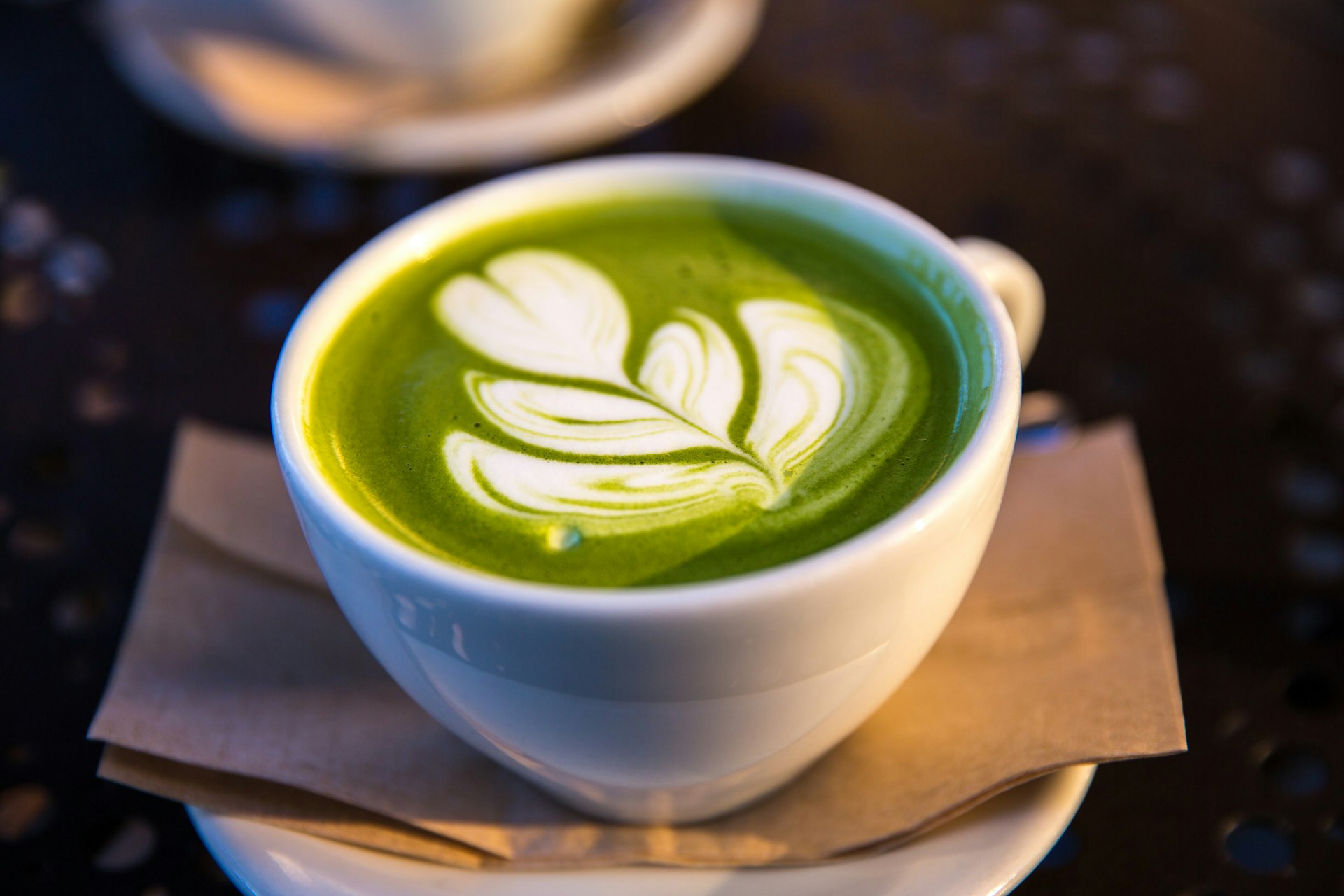
The Science of Brewing Matcha:
A Complete Guide to the Perfect Bowl
From colloidal physics to fluid dynamics — why every degree, every stroke, and every grain of powder matters in the pursuit of the perfect cup.
Matcha isn’t tea dissolved in water — it’s a three-phase colloidal suspension where solid particles, liquid, and micro-foam exist in delicate balance.
Get the science right, and every bowl becomes extraordinary.
Below: peer-reviewed science from food chemistry, colloid physics & fluid mechanics — translated into steps you can follow in your kitchen today.
Understanding Matcha as a Physical System
Unlike steeped teas (sencha, oolong, black tea), matcha is a whole-leaf consumption method. The tea leaves — ground into particles averaging 5–10 microns — are permanently suspended in the liquid and consumed entirely. There’s no straining, no discarding.
In colloidal chemistry terms, matcha is a thermodynamically unstable “gas-liquid-solid” system. The solid phase consists of ultra-fine tea particles. The liquid phase is hot water enriched with extracted biochemicals (L-theanine, catechins, caffeine). The gas phase is the micro-foam network created by whisking.
Why this matters: At 5–10 microns, gravity’s pull on each particle is dramatically reduced, while Brownian motion — the random jostling from water molecules — helps keep particles suspended. But this equilibrium is fragile. Without proper technique, gravity wins and your matcha settles into sediment.
Step 1: Sift Your Matcha — Breaking Molecular Bonds
Before water ever touches your matcha, you need to address a fundamental problem: particle agglomeration.
Matcha particles are so small that van der Waals forces and static electricity dominate their behavior. During storage, shipping, and compression in packaging, these microscopic forces cause particles to clump into pebble-like aggregates that can be tens of times larger than individual grains.
When hot water hits these dense clumps, the surface polysaccharides, proteins, and saponins instantly absorb moisture and swell into a thick, impermeable gel barrier. Water can’t penetrate to the core. The undissolved mass sinks to the bottom, forming what tea professionals politely call “green sludge” — bitter, gritty, and impossible to reincorporate with a spoon.
The fix: Use a fine-mesh stainless steel sieve. Press the powder through with a spoon or the back of a spatula. This mechanical shearing breaks the van der Waals and electrostatic bonds, dispersing the powder into individual particles with maximum surface area for water contact.
Step 2: Temperature — The Golden Window of 70–80°C
Temperature is the master variable in the matcha system. It governs extraction kinetics, molecular stability, and foam formation — all at once.
Too Cold (Below 60°C)
Water molecules lack the thermal energy to penetrate the waxy, lipid-rich surface of matcha particles. Cold water beads on the oily powder surface instead of wetting it. Natural foaming agents (saponins) dissolve too slowly to reach their critical micelle concentration, resulting in failed foam and heavy sedimentation.
Too Hot (Above 80°C / Boiling)
Excessive heat triggers a chain of irreversible damage:
- L-theanine degradation — The amino acid responsible for matcha’s sweet umami flavor denatures, destroying the clean sweetness and micro-foam stability.
- Exponential catechin extraction — EGCG and related polyphenols flood the cup at high concentrations, overwhelming umami with harsh bitterness and astringency.
- Chlorophyll pheophytinization — Hydrogen ions displace the central magnesium ion in chlorophyll’s porphyrin ring, causing an irreversible color shift from vivid green to olive-brown.
The Sweet Spot: 70–80°C (158–175°F)
At this precise range, thermal energy is sufficient to melt plant waxes, fully solubilize saponins for foaming, and extract balanced levels of catechins and amino acids — while keeping chlorophyll structurally intact and L-theanine preserved.
Practical tip: Boil your water, then let it cool for 2–3 minutes, or pour it into a secondary vessel (like a yuzamashi) before pouring over your matcha. A kitchen thermometer removes all guesswork.
Step 3: Preheat Your Bowl — Eliminating the Heat Sink
This step, central to Japanese tea ceremony (chanoyu), has a solid physics rationale.
A room-temperature ceramic chawan has significant heat capacity and low initial temperature — it functions as a cold-source heat sink. When 80°C water enters an unheated bowl, transient heat conduction causes the liquid temperature to plummet 10–15°C within seconds.
This temperature crash stalls extraction. Saponins stop dissolving. Partially suspended macromolecules begin to flocculate and settle. You lose both flavor and foam potential in the first critical seconds of preparation.
Solution: Fill your chawan with boiling water and let it sit for 30–60 seconds. Pour it out, dry with a clean cloth, then add your sifted matcha. Now your bowl is a thermally neutral container that won’t steal energy from your careful 80°C water.
Step 4: Water Quality — The Invisible Variable
The chemical composition of your water — its mineral content and pH — directly determines the color clarity, flavor profile, and foam stability of your matcha.
| Parameter | Optimal Range | What Goes Wrong Outside the Range |
|---|---|---|
| Hardness (TDS) | 30–80 ppm (soft water) | Ca²⁺ and Mg²⁺ ions chelate with catechins, forming insoluble metal-polyphenol complexes. Result: cloudy, muddy appearance with a metallic aftertaste. |
| pH | 6.0–7.0 (slightly acidic) | Alkaline water (pH > 7.5) catalyzes auto-oxidation of polyphenols, increasing bitterness and accelerating color degradation. |
| Chlorine | 0 ppm (zero) | Hypochlorous acid irreversibly oxidizes volatile aromatic compounds, replacing natural fragrance with a chemical off-taste. |
Best practice: Use filtered or spring water with TDS between 30–80 ppm. If your tap water is hard or chlorinated, a simple charcoal filter (like Binchotan or a pitcher filter) makes a noticeable difference. Avoid distilled water — a small amount of minerals actually provides beneficial ionic bridging that supports foam structure.
Step 5: The Paste Phase — An Ancient Technique With Modern Physics
Before whisking in full water volume, prepare a concentrated paste. This technique, known as diancha (点茶), originated in Song Dynasty China and has been validated by modern colloid physics.
Why it works: Adding the full amount of water immediately creates a low-viscosity system. In thin liquid, the chasen’s tines slide over clumps rather than shearing them apart — the clumps act like oiled ball bearings, deflecting mechanical energy instead of absorbing it.
By using only about 10% of your total water volume first, you create a high-viscosity, non-Newtonian paste. In this concentrated state, inter-particle distances are minimal and fluid resistance is enormous. Every stroke of the chasen transfers its full mechanical energy directly into crushing undissolved aggregates. Once the paste is completely smooth, gradually add the remaining water to avoid concentration shock.
Step 6: Whisking — Fluid Dynamics in a Bowl
This is where the liquid-solid system transforms into the velvety gas-liquid-solid micro-foam that defines great matcha.
Chasen vs. Electric Frother: The Physics
An electric frother’s spinning rotor creates a single macro-scale cavitation vortex — it sucks air into the liquid rapidly, but the bubbles are large and unevenly distributed. According to the Laplace equation, large bubbles have low internal pressure and thin walls. They merge and pop within seconds, like soap foam.
A traditional bamboo chasen (茶筵), with its 80–120 fine tines, is an entirely different instrument. Each tine acts as a micro-shear force multiplier, simultaneously creating hundreds of parallel mini-vortices. The resulting turbulent flow field breaks air masses into micron-scale bubbles with thick, stable walls — the dense, creamy micro-foam that characterizes ceremonial matcha.
Optimal Technique: The “W” Trajectory at 8 Hz
Research from Osaka Metropolitan University, using motion-capture analysis of tea ceremony experts, found that master practitioners whisk at approximately 8 strokes per second (8 Hz) during the initial foaming phase. The key details:
- Trajectory: Rapid “W” or “M” shaped back-and-forth motions — not circular stirring. These abrupt direction changes create chaotic advection, continuously breaking boundary-layer stability.
- Depth: The energy must be concentrated at the surface level of the liquid. Plunging the chasen deep wastes energy on frictional resistance against the bowl bottom instead of incorporating air at the surface.
- Duration: Approximately 15–20 seconds of high-frequency whisking, followed by slower, broader strokes to distribute and equalize the foam.
The Chemistry of Foam Stability
Once micro-bubbles are created, the biochemical components of matcha take over to keep them alive:
- Saponins — These natural surfactants rapidly self-assemble at gas-liquid interfaces, their hydrophilic sugar chains in water and hydrophobic triterpenoid backbone in the air pocket. They dramatically lower surface tension, enabling foam to form at relatively low whisking energy.
- EGCG (Catechin) — Research from Zhejiang University found that EGCG amplifies foaming capacity by up to 1.89× through enhanced intermolecular cross-linking at bubble interfaces. Peak efficiency occurs near pH 6.0.
- Amino acids & Pectins — Large molecules like valine, soluble plant proteins, and high-molecular-weight pectins entangle between bubble walls, creating a three-dimensional hydrogen-bond network. This steric hindrance effect resists gravity drainage and prevents bubble merger.
- Stone-ground particles — The jagged, irregular particles from traditional granite milling physically embed in bubble walls like a Pickering emulsion, reinforcing the thin liquid film into a composite armor that dramatically extends foam half-life.
Protecting the Green: Chlorophyll Under Threat
Matcha’s vibrant emerald color is both its most recognizable quality signal and its most fragile attribute. The color comes from high concentrations of chlorophyll a and b — molecules built around a porphyrin ring with a central magnesium ion.
When exposed to heat, light, or acidic conditions, chlorophyll undergoes pheophytinization: hydrogen ions violently displace the magnesium, collapsing the electronic structure of the porphyrin ring. The visible result is a spectral blue-shift — the absorption peaks shift, and the vivid green fades irreversibly to olive-brown.
Chlorophyll degradation follows first-order reaction kinetics and obeys the Arrhenius equation: even a 10–15°C temperature increase above the optimal range causes degradation rates to spike exponentially. This is precisely why the 70–80°C temperature window isn’t merely a preference — it’s a hard constraint for preserving both color and the antioxidant activity associated with intact chlorophyll.
Storage note: Once opened, store your matcha in an opaque, airtight container in the refrigerator. Light, heat, and oxygen are all catalysts for chlorophyll breakdown, even in dry powder form.
The Complete Protocol: Five Steps to a Perfect Bowl
- Sift before brewing — Van der Waals forces and static electricity cause clumps that hot water alone cannot dissolve. Mechanical sieving is non-negotiable.
- 70–80°C is a hard boundary — Below this range, extraction stalls. Above it, L-theanine degrades, catechins flood the cup with bitterness, and chlorophyll turns olive-brown.
- Preheat the bowl — An unheated ceramic bowl causes a 10–15°C temperature crash in seconds, sabotaging extraction and foam formation.
- Water chemistry matters — Use soft, slightly acidic water (TDS 30–80 ppm, pH 6.0–7.0) with zero chlorine. Hard water chelates catechins into insoluble complexes.
- Paste first, then whisk — The ancient diancha technique creates a high-viscosity paste that transfers 100% of mechanical energy into breaking clumps.
*These statements have not been evaluated by the Food and Drug Administration. This product is not intended to diagnose, treat, cure, or prevent any disease. The scientific information in this article is provided for educational purposes based on published peer-reviewed research. Individual experiences may vary.
Ready to Experience the Difference?
Start with stone-ground ceremonial matcha from Uji, Kyoto — crafted for the kind of bowl this guide describes.
Explore Our CollectionFrequently Asked Questions
What is the ideal water temperature for brewing matcha?
The ideal water temperature is between 70°C and 80°C (158°F–175°F). This range provides enough thermal energy to dissolve plant waxes and release natural foaming agents like saponins, while preserving L-theanine, chlorophyll, and avoiding excessive extraction of bitter catechins.
Why does my matcha clump and how do I prevent it?
Matcha powder clumps due to van der Waals forces and static electricity between ultra-fine particles (5–10 microns). Sifting through a fine mesh strainer before brewing mechanically breaks these bonds and creates an aerated powder that disperses evenly in water.
Does water quality affect matcha taste?
Yes — significantly. Hard water (high in calcium and magnesium) causes metal ions to chelate with catechins, forming insoluble compounds that make the tea cloudy and metallic-tasting. Use soft water with TDS between 30–80 ppm and a pH of 6.0–7.0 for best results.
Why is a bamboo chasen better than an electric frother?
A bamboo chasen has 80–120 fine tines that create hundreds of parallel micro-vortices, producing a dense, long-lasting micro-foam. Electric frothers create a single large cavitation vortex that produces short-lived macro-bubbles which collapse quickly due to thin bubble walls and uneven distribution.
What makes matcha lose its vibrant green color?
The green color comes from chlorophyll. When exposed to heat, light, or acidic conditions, chlorophyll undergoes pheophytinization — a reaction where the central magnesium ion is displaced by hydrogen ions. This causes the vivid green to fade irreversibly to olive-brown, and is accompanied by loss of antioxidant activity.
Why should I preheat the tea bowl before making matcha?
A room-temperature ceramic bowl acts as a heat sink, absorbing thermal energy from the water and causing the temperature to drop 10–15°C within seconds. This stalls extraction, prevents proper foaming, and destabilizes the colloidal suspension. Preheating with boiling water eliminates this temperature gradient.